
How Bench Warrants Work in Renville County
People say bench warrant. The Minnesota paperwork usually says something else, calling the process one issued to obtain a person's appearance after they missed a court obligation. Renville County's own warrant table has no column separating the types, so the label alone tells you little. Whatever the wording, the trigger is the same. A judge issues the process to bring someone back before the court after a missed obligation.
Renville County Warrant: Sign-and-Release vs. Arrest
Two Renville County warrant outcomes look identical on a published list yet behave very differently in person. One authorizes custody. The other is a statutory notice process that simply sets a new court date.
| Question | Sign-and-Release Warrant | Arrest-Authorizing Warrant |
|---|---|---|
| Does it allow arrest? | No | Yes |
| Is bail required? | No | Set by the court |
| Officer's action | Written notice of a new date | Custody |
| What ends it? | Inactivation under the statute | Arrest, appearance, recall, or bond |
| Eligibility | Certain misdemeanor failures | Case-specific order |
The sign-and-release process comes from Minn. Stat. §629.415, which also lets a Renville County prosecutor request a bail warrant when safety requires one.
Bench Warrant Issuance in Renville County
A judge issues the warrant, not the sheriff and not the prosecutor. In Renville County that judge sits on the district court, which holds original jurisdiction over the criminal and traffic cases filed here. The triggers vary. A missed appearance after notice, a release condition violation, a probation problem, noncompliance with an order, or an unanswered citation a judge escalated can each start the process. The county table publishes the result without the reason. For the event behind it, check the Register of Actions through Minnesota Government Access.
Four Renville County Warrant Labels Compared
Four labels show up in Minnesota records, and a reader who treats them as identical will ask the wrong Renville County office for help. The labels carry different meanings.
- Appearance warrant
- Brings a person back before the judge after a missed event.
- Probation violation warrant
- Tied to alleged probation or sentence condition violations.
- Contempt
- A court enforcement category with its own custody consequence.
- Writ of attachment
- A civil or family step that is not automatically a criminal warrant.
- Recall
- The court action that withdraws the warrant, from the issuing judge only.
How Bench and Arrest Warrants Differ
Both papers come from a judge and can end in custody. The difference is the trigger. An arrest warrant follows a charge and a probable cause finding, while an appearance warrant follows a missed obligation on a case already filed in Renville County.
| Question | Appearance or Bench Warrant | Arrest Warrant |
|---|---|---|
| Trigger | Missed date or unmet condition | Charged offense and probable cause |
| Charge already filed? | Usually yes | Yes, with the complaint |
| Typical first fix | New date, payment, or motion | Counsel and an appearance |
| Where it starts | Court Administration | Court Administration and counsel |
The arrest warrant lookup page covers the custody process after a charge-based warrant.
Renville County Bench Warrant Keeps Case Open
Clearing a warrant and closing a case are two different events. A warrant is a court process attached to a live case. When it is recalled, served, or resolved, the case keeps going: hearings continue, conditions still apply, and a disposition still has to be entered. The reverse holds too. A payment can satisfy a fine while an appearance requirement stays open. Age does not settle anything either. Minnesota publishes no rule that ages a warrant out, and the Renville County list has carried older entries, so an old issue date is not an expiration date. Ask the court whether the warrant was recalled, served, or superseded.
Clearing a Bench Warrant in Renville County
Resolution runs in a fixed order. Identify the case and the reason, ask the Renville County court what step it wants, complete that step, then confirm the status change on both sides. Skipping the confirmation step is how people end up re-arrested on a warrant they thought was handled.
Caution: a person may be taken into custody when they appear in person while an active warrant exists. Call Court Administration and speak with an attorney before you travel to any county building.
Ask whether the matter is sign-and-release, bond-required, probation-related, or payable, and what the court wants next: a payment, a new date, a written motion, or an attorney appearance. Staff can explain procedure, but they cannot promise a recall. If the court orders a surrender or a bond, the Renville County jail handles custody logistics at 320-523-3600. Minnesota court guidance says bail or bond may be posted at the jail or the criminal court, and that some bail must be cash only. Confirm the amount, the accepted payment type, and the location before you go. The Renville County Jail page covers custody, booking, and jail security rules, along with what a person in custody and their family can expect from the facility.
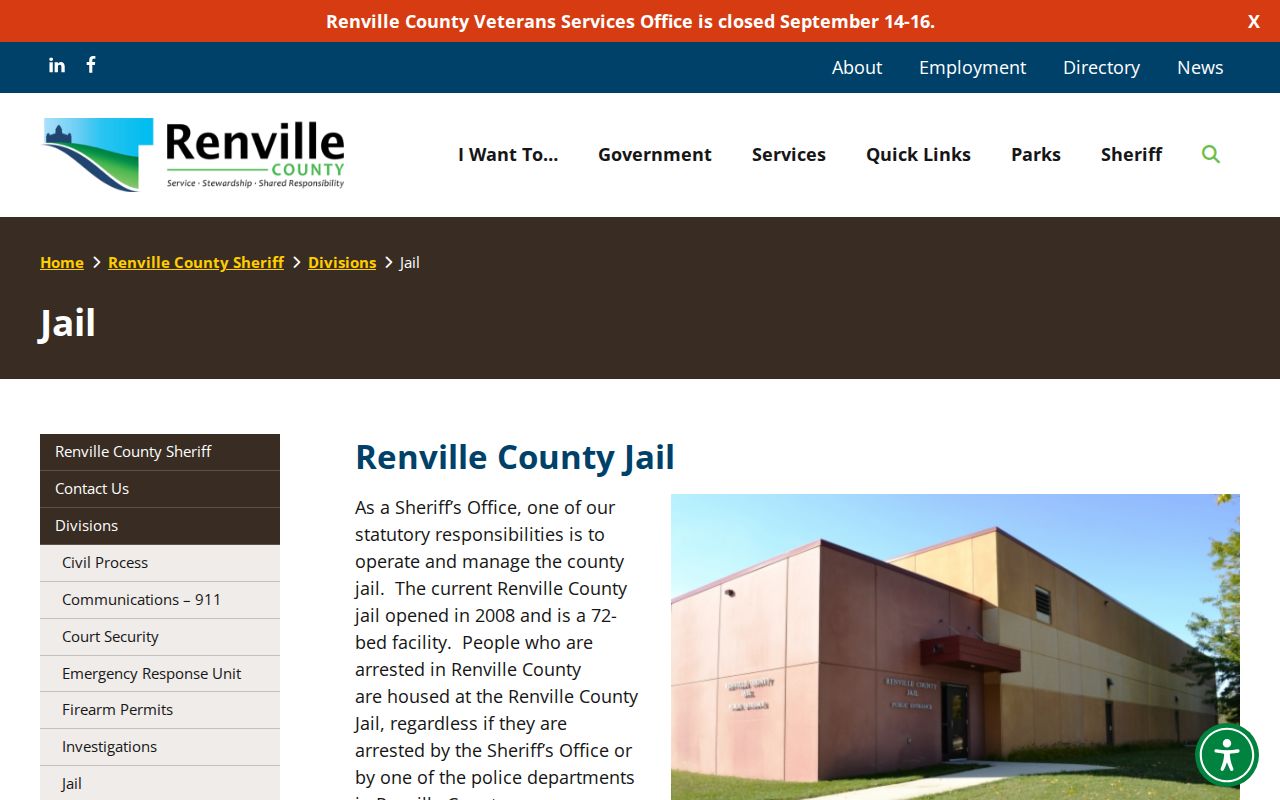
The Renville County jail is the custody endpoint for arrests made anywhere in the county, including arrests by city police.
Missed Traffic Date: Pay or Appear?
A missed traffic date is the most common way people land on a Renville County warrant list, and the fix depends on the citation itself. Minnesota divides citations into payable offenses and offenses that require an appearance, and the district court sets which is which. Look at the ticket and find the citation number. Then determine whether the court designated the offense payable, whether the response window has closed, and whether a failure-to-appear event has been entered. The state pay-a-fine page explains payment channels and the deadlines that apply to a payable citation. Paying one counts as a guilty plea, so contest the charge or ask about a payment plan before you send money.
Renville County Courts That Issue Bench Warrants
Renville County has one answer to this question. The district court holds original jurisdiction over criminal, traffic, family, juvenile, and civil matters filed in the county. City ordinance offenses go into the same statewide case system, and the district court designates which offenses are payable and in what amounts. There is no separate justice-of-the-peace or municipal court warrant desk here. What a reader thinks of as a city warrant is still a district court case. Court Administration sits at 500 E. DePue Ave. on the third level in Olivia and answers 320-523-3680 on weekdays. The Renville County District Court page lists hours, parking, and the weekly public calendar.
Calling Court Administration Before Walking In
A phone call to Renville County court administration can settle most of what the file shows and what steps come next, though staff give procedure rather than legal advice. Pull the case or citation number first. When someone answers, ask what triggered the warrant and where the matter stands. Ask whether the warrant authorizes arrest. Ask what the issuing court wants from you now, and whether a lawyer can handle the appearance instead of you. Afterward, jot down the date, the staff member's name, and every instruction you received.
The 36-Hour Prompt-Appearance Rule
An arrest on a Renville County warrant starts a clock. Minnesota Rule of Criminal Procedure 3 controls what must happen next: the arresting officer has to tell the person about the warrant and the underlying charge, then bring them before the issuing court or an available judge promptly. Courts do not sit around the clock. If the Renville County court is not in session, the rule sets an outer limit of 36 hours after arrest, and the day of arrest does not count. The rule also restricts when a misdemeanor warrant may be executed, apart from a few narrow exceptions. Treat the 36-hour window as a safeguard rather than a promise of quick release. Booking, conditions, other holds, and the judge's availability all move the timeline. The full criminal rule lays out every requirement.